Tree Decisions
How to Choose a Tree Service in Abilene Without Guessing
Use credentials, insurance, written scope, safety questions, references, and site-specific planning to choose a tree service for an Abilene property.
Tree work can place people, equipment, heavy limbs, and nearby property in the same small area. Choosing a tree service should therefore involve more than asking whether someone owns a saw or can arrive quickly. The provider should be able to explain the proposed scope, the site constraints, and what the property will look like afterward.
You do not need to become an arborist to make a careful choice. You can verify credentials that are claimed, request current proof of insurance, ask for references, and insist on a written scope. You can also notice whether the estimate addresses your actual tree and access route instead of relying on a generic description.
Match qualifications to the work you need
First define whether the request involves pruning, removal, storm debris, stump grinding, or brush clearing. Then ask who will perform the work and what training or relevant experience supports that task. Large-tree pruning, technical removal, and work near electrical conductors involve different hazards from ground-level cleanup.
ISA certification is voluntary and belongs to an individual, not automatically to every employee of a company. If a provider claims an ISA credential, use ISA's current directory or digital credential tools to verify the person and status. Do not assume a logo, company name, or verbal claim establishes a credential.
Verify insurance and business details directly
Ask for current proof of insurance appropriate to the work and contact the listed insurer or agent if verification is important to your decision. Confirm the business name on the proposal, who your point of contact is, and whether any permits or local requirements apply to the property or work area.
Texas A&M AgriLife Extension and ISA consumer guidance both recommend asking for proof of insurance and references. A careful provider should be willing to identify the party responsible for the work and put the agreement in writing without asking you to rely only on an informal conversation.
Look for a property-specific safety conversation
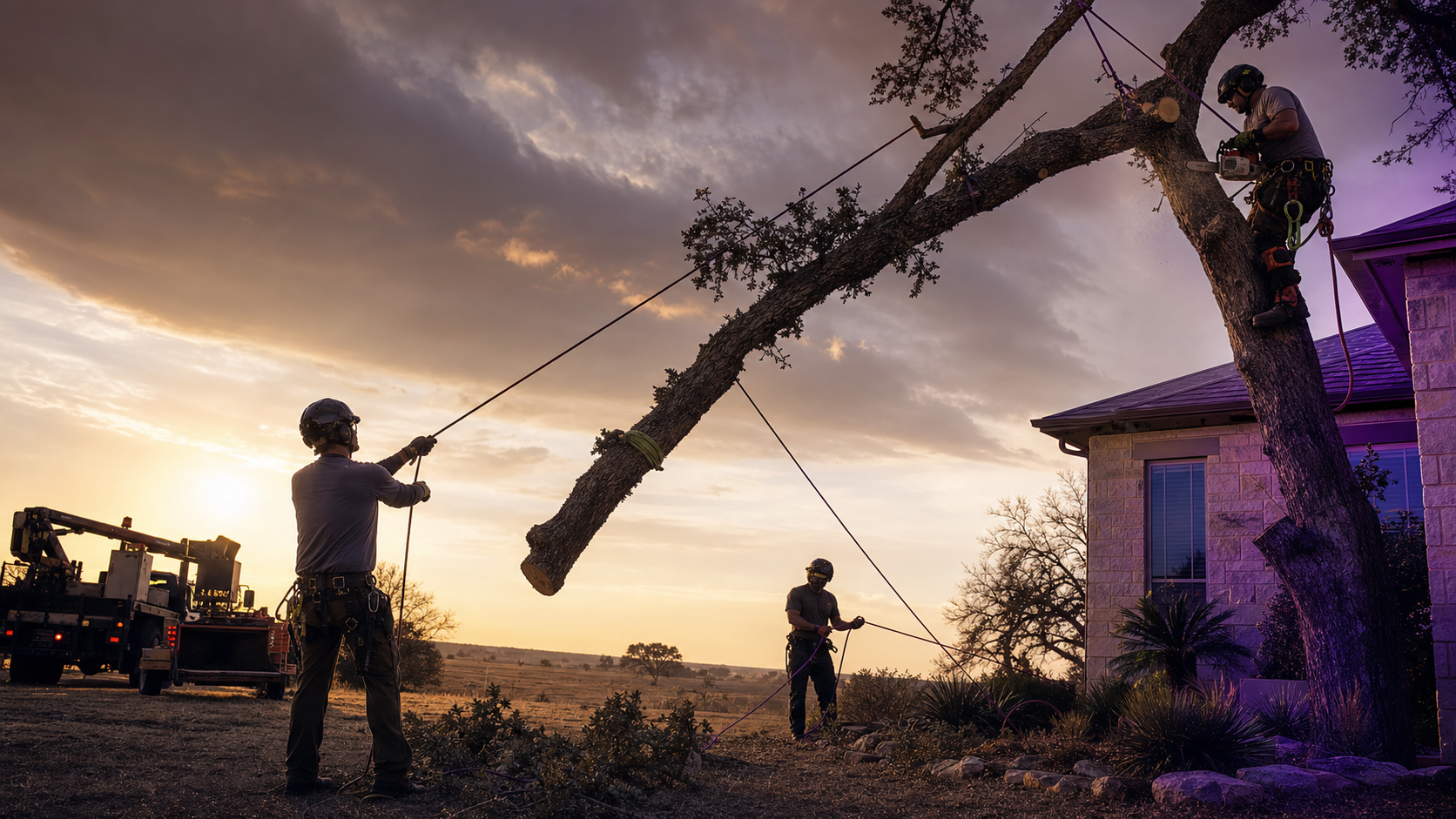
A useful estimate should recognize the hazards that actually exist at the site: elevated work, falling material, chainsaws or chippers, traffic, bystanders, structures, and overhead power lines. OSHA identifies falls, struck-by incidents, cuts, and electrical contact among the major hazards in tree-care operations.
Ask how the work area will be kept clear and what you must move or secure before the crew arrives. You are not asking for proprietary operating detail; you are checking whether the provider noticed the driveway, gate, roof, line, or pedestrian route that makes your property specific. Treat any tree touching a power line as a utility issue first and stay away.
Require a scope you can read before accepting
The written proposal should name the tree or marked area, describe the trimming objective or removal work, and state what happens to limbs, logs, chips, small debris, and the stump. It should also list access assumptions, exclusions, property-owner preparation, and any item that will be decided separately.
For pruning, be cautious with vague instructions that do not identify an objective. ISA guidance says each pruning cut should have a reason and explains that topping can damage tree structure and promote weakly attached regrowth. Ask what result the proposed cuts are meant to achieve rather than accepting an undefined promise to trim everything back.
- Specific tree or work boundary
- Defined pruning, removal, cleanup, stump, or clearing result
- Debris destination and expected site finish
- Access requirements, exclusions, and scheduling terms
Check references for communication and scope follow-through
When you contact a reference, ask questions you can reasonably verify: Did the crew perform the written scope? Were access and cleanup expectations clear? Did the company communicate when site conditions or timing changed? Was the finished area consistent with the agreement? These questions are more useful than asking for a general rating.
Take enough time to read the proposal and resolve unclear language. The goal is not to obtain a promise that nothing can go wrong or that a tree will never fail. It is to choose a provider whose qualifications, coverage, site review, and written plan fit the work in front of you.
Common questions
Answers before you make the call.
What should I verify before hiring an Abilene tree service?
Verify any claimed credentials, request current proof of insurance, identify who will perform the work, check references, and review a written scope that covers access, included work, debris, exclusions, and the final site condition.
Does an ISA credential apply to an entire tree-service company?
No. ISA credentials are held by individuals. Ask which credentialed person is involved and verify that person's current status through ISA's credential tools rather than assuming the whole company is certified.
What is a warning sign in a tree-trimming proposal?
A vague promise to cut a tree back without naming the pruning objective or target branches deserves clarification. Ask what result the cuts are intended to achieve and make sure that objective appears in the written scope.
Primary references
Sources behind this guide.
Official and industry sources support the guidance above. Site conditions still require project-specific review.
Local service information
Near Abilene?
Review availability and property considerations in these nearby communities.
View all service areas