
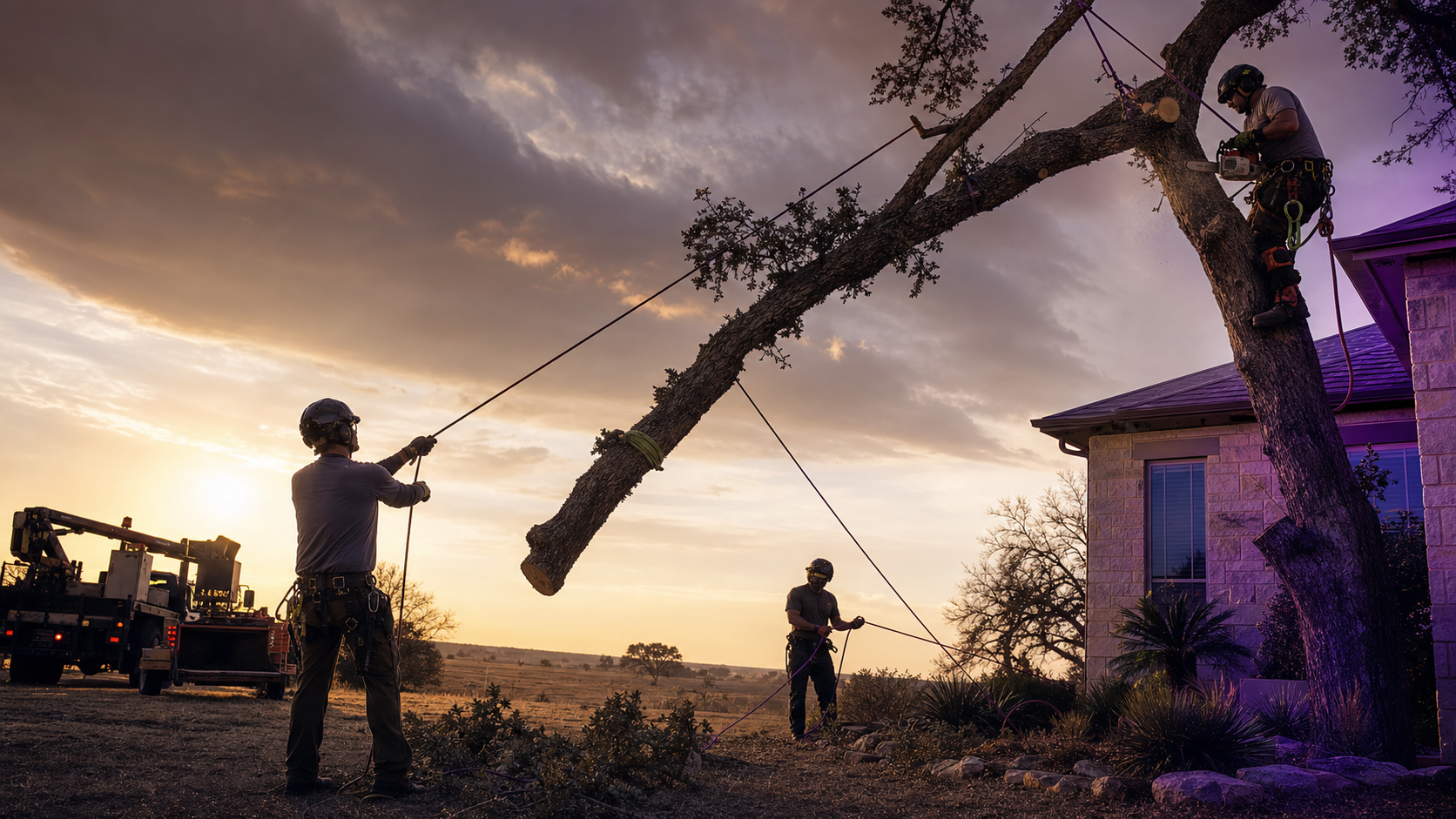
Property Planning
When Should Trees Be Trimmed in West Texas?
Understand how species, oak wilt guidance, tree condition, pruning purpose, drought stress, and storm damage affect tree-trimming timing in West Texas.
There is no single best month for every West Texas tree. Timing depends on the species, the reason for pruning, current condition, recent weather, disease considerations, and whether a branch presents an immediate safety concern. A calendar can start the conversation, but it cannot replace looking at the actual tree and target limbs.
Routine structural work, clearance pruning, storm response, and removal of dead or broken branches are different decisions. Before requesting a date, identify the tree if possible, describe the goal, and document changes in its canopy or trunk. That information helps a tree-care professional decide whether the work can follow a preferred seasonal window or needs a condition-led response.
Let the pruning purpose set the first timing question
Begin with the problem to solve: a broken branch, roof or driveway clearance, visibility, young-tree structure, or management of mature-tree defects. Texas A&M Forest Service notes that light removal of dead, damaged, weak, or diseased branches may be possible at many times, while heavier removal of live foliage deserves more attention to growth stage and stress.
A request for broad canopy reduction is not interchangeable with removing one failed limb. Ask which branches are proposed, why each cut supports the goal, and how much live canopy would be affected. ISA guidance warns that inappropriate pruning can weaken a tree, and support systems or pruning cannot guarantee that a tree will never fail.
Treat oaks as a separate disease-prevention decision
Oak species require a specific Texas caveat because fresh wounds can contribute to oak wilt spread. Texas A&M Forest Service generally advises avoiding pruning or wounding oaks from February through June and painting fresh oak wounds immediately. Confirm current local guidance, tree identity, and any necessary exception before scheduling routine oak work.
Do not apply the oak rule mechanically to every tree or use leaf symptoms to diagnose oak wilt from a distance. All oaks can be susceptible, but diagnosis and management depend on species and site context. A qualified arborist or Texas A&M Forest Service resource is appropriate when several nearby oaks decline, symptoms change quickly, or oak wilt is suspected.
Match timing to species and plant response
Deciduous shade trees, evergreens, spring-flowering trees, fruiting trees, and multi-stem ornamentals do not all respond identically or share the same pruning goal. For example, timing can affect whether spring-flowering plants retain their next display, while species with meaningful pest or disease windows may have additional restrictions. Correct identification should come before a species-based schedule.
Avoid relying on a generic list that labels all mesquite, elm, oak, or ornamental trees the same. Trees within a group can differ, and a landscape cultivar may not follow assumptions made from bark or leaf shape in one photo. When identification is uncertain, capture leaves, branching, bark, the whole canopy, and any flowers or fruit without entering an unsafe area.
Use condition and recent weather to qualify the calendar
Drought, extreme heat, freeze injury, construction impacts, and a recent flush of spring growth can leave a tree with less tolerance for extensive live-branch removal. Texas A&M Forest Service cautions against heavy pruning of live branches just after spring growth, especially on stressed trees. That guidance supports restraint, not a remote diagnosis based only on thin foliage.
Photograph the full canopy and compare it with earlier images if available. Note irrigation changes, trenching, grade changes, vehicle traffic over roots, lightning, wind, or abrupt leaf loss. A professional may recommend a narrower scope, monitoring, a different season, or an assessment before pruning; none of those outcomes should be promised without reviewing the tree.
Separate urgent hazards from routine seasonal work
A hanging branch, fresh split, or tree contact with an overhead line is a safety issue before it is a calendar question. Keep people away from unstable material. Treat every downed or tree-contacted line as energized and contact the utility; do not approach for a closer photograph or attempt pruning near the line.
For non-urgent work, request a written scope that names the target branches and purpose, protects branch collars, avoids topping, addresses debris, and acknowledges that trimming cannot make a tree storm-proof. Large-tree pruning requires training and equipment, and ISA recommends qualified arborists for work where tree condition, structure, or risk needs professional judgment.
- Tree identity or uncertainty about species
- Reason for pruning and target branches
- Visible changes and recent site disturbance
- Nearby roofs, roads, fences, and utility lines
- Whether the concern is urgent or routine
Common questions
Answers before you make the call.
Is winter always the best time to trim a West Texas tree?
No. Dormancy can be useful for some routine work, but species, pruning purpose, health, recent stress, flowering goals, disease windows, and safety concerns can change the decision. Review the actual tree rather than choosing a date from season alone.
Should an oak be trimmed in spring?
Texas A&M Forest Service generally advises avoiding oak pruning and wounding from February through June because of oak wilt risk and recommends immediately painting fresh oak wounds. Check current guidance and seek qualified advice for storm damage or another condition that may not wait for routine timing.
Can trimming guarantee that a tree will survive the next storm?
No. Pruning may address defined branches or defects, but no pruning scope can guarantee future tree performance. Site exposure, hidden conditions, weather, roots, structure, and later changes all affect risk.
Primary references
Sources behind this guide.
Official and industry sources support the guidance above. Site conditions still require project-specific review.
Local service information
Near Abilene?
Review availability and property considerations in these nearby communities.
View all service areas